Research Progress
Habitat Complexity and Detritus Safeguard Fish Diversity and Food Web Dynamics in Irrawaddy Delta Mangroves
Mangrove ecosystems in tropical estuaries serve as critical transitional habitats supporting coastal biodiversity, regional fisheries, and estuarine food webs. In Myanmar's Irrawaddy Delta, extensive mangrove conversion to agricultural land and seasonal monsoonal fluctuations pose significant threats to aquatic life. While species checklists exist, understanding how habitat complexity, water quality, and trophic structures interact to shape fish communities has remained a central challenge for estuarine ecology and conservation in Southeast Asia.
In a study published in Journal of Fisheries, a research team led by Prof. Xiao Yong Chen from the Kunming Institute of Zoology (KIZ) of the Chinese Academy of Sciences, along with collaborators from the Southeast Asia Biodiversity Research Institute (SEABRI) and the Forest Department of Myanmar's Ministry of Natural Resources and Environmental Conservation, revealed that structural habitat complexity and mangrove-derived organic inputs (detritus), rather than water quality parameters alone, act as primary drivers structuring fish assemblages and food web dynamics in the Irrawaddy Delta.
Conducting comprehensive seasonal field surveys across 24 sampling plots in Bogale and Pyapon Townships alongside local market surveys, the team documented 129 fish species spanning 64 families and 19 orders. Four IUCN Red List threatened species were identified, including the Endangered Eleutheronema tetradactylum and Johnius macrorhynus, as well as the Vulnerable Narcine timlei and Tenualosa toli. Seasonal analysis showed that species richness peaked during the post-monsoon winter season (95 species) and reached its lowest during the pre-monsoon summer season (77 species). Despite these seasonal shifts in richness, Pielou's species evenness remained remarkably stable (0.77–0.78), indicating a resilient and balanced community structure.
Using permutational multivariate analysis of variance (PERMANOVA) and three-dimensional non-metric multidimensional scaling (NMDS) ordination, the researchers mathematically proved a highly significant divergence in community composition between natural mangrove forests and areas converted for agricultural use (F = 4.19, R² = 0.15, P = 0.001). Functional feeding guild assessments further demonstrated that mangrove habitats are overwhelmingly dominated by benthivores and detritivores, highlighting that leaf litterfall and decomposing organic matter from intact mangrove root systems serve as the foundational energy source for the estuarine food web.
This study provides the first comprehensive molecular and ecological benchmark for the Irrawaddy Delta's fish fauna. The findings demonstrate that conserving the physical integrity and organic energy inputs of core mangrove forests is essential for sustaining regional fisheries and safeguarding endangered species, offering critical scientific evidence for ecosystem-based fisheries management in Myanmar.

Figure 1: Geographical location of the study area in the Irrawaddy Delta, Myanmar, depicting the 24 standardized sampling plot sites across Bogale and Pyapon townships in forested mangrove and agricultural land habitats.

Figure 2: Comparison of fish community biodiversity indices—(a) Species Richness, (b) Shannon Diversity (H'), (c) Simpson Diversity (1-D), and (d) Pielou's Evenness (J')—across summer, rainy, and winter seasons between mangrove forested plots and agricultural land.
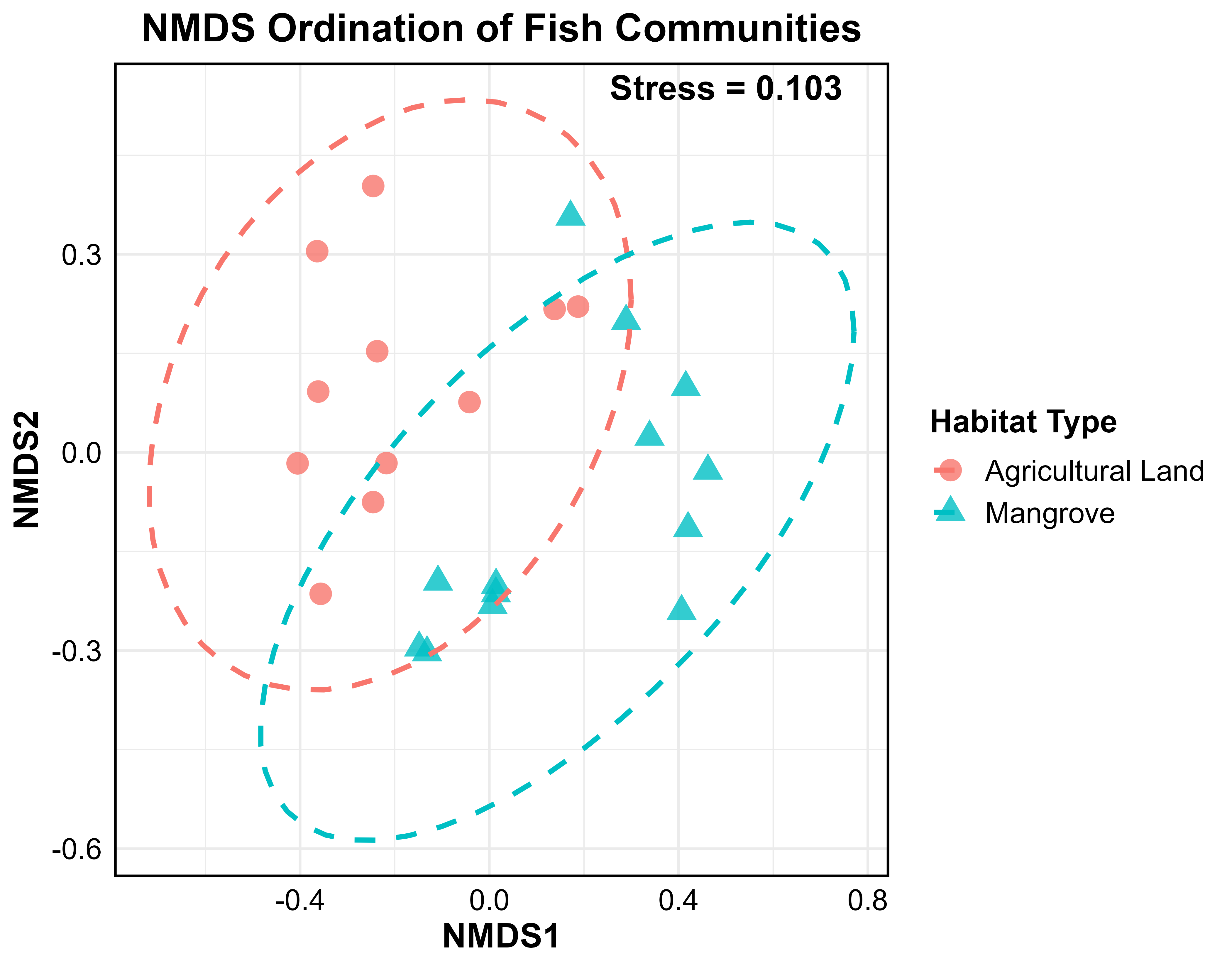
Figure 3: Non-metric Multidimensional Scaling (NMDS) ordination plot (Stress = 0.103) based on fourth-root transformed abundance data, illustrating clear spatial separation and clustering between mangrove forest fish assemblages and agricultural land habitats.
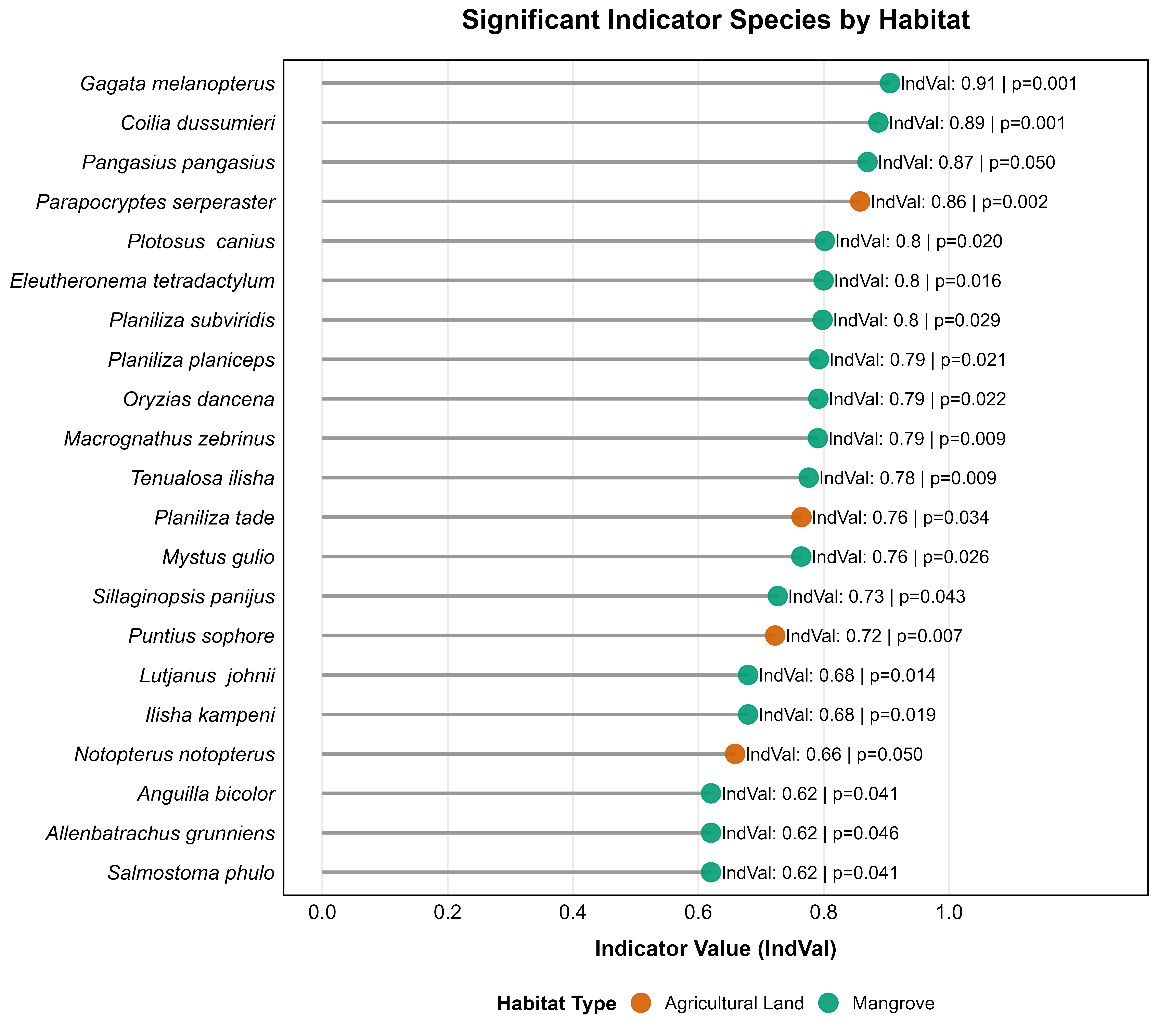
Figure 4: Significant indicator species identified by Indicator Species Analysis (ISA) for mangrove forest versus agricultural land habitats in the Irrawaddy Delta.
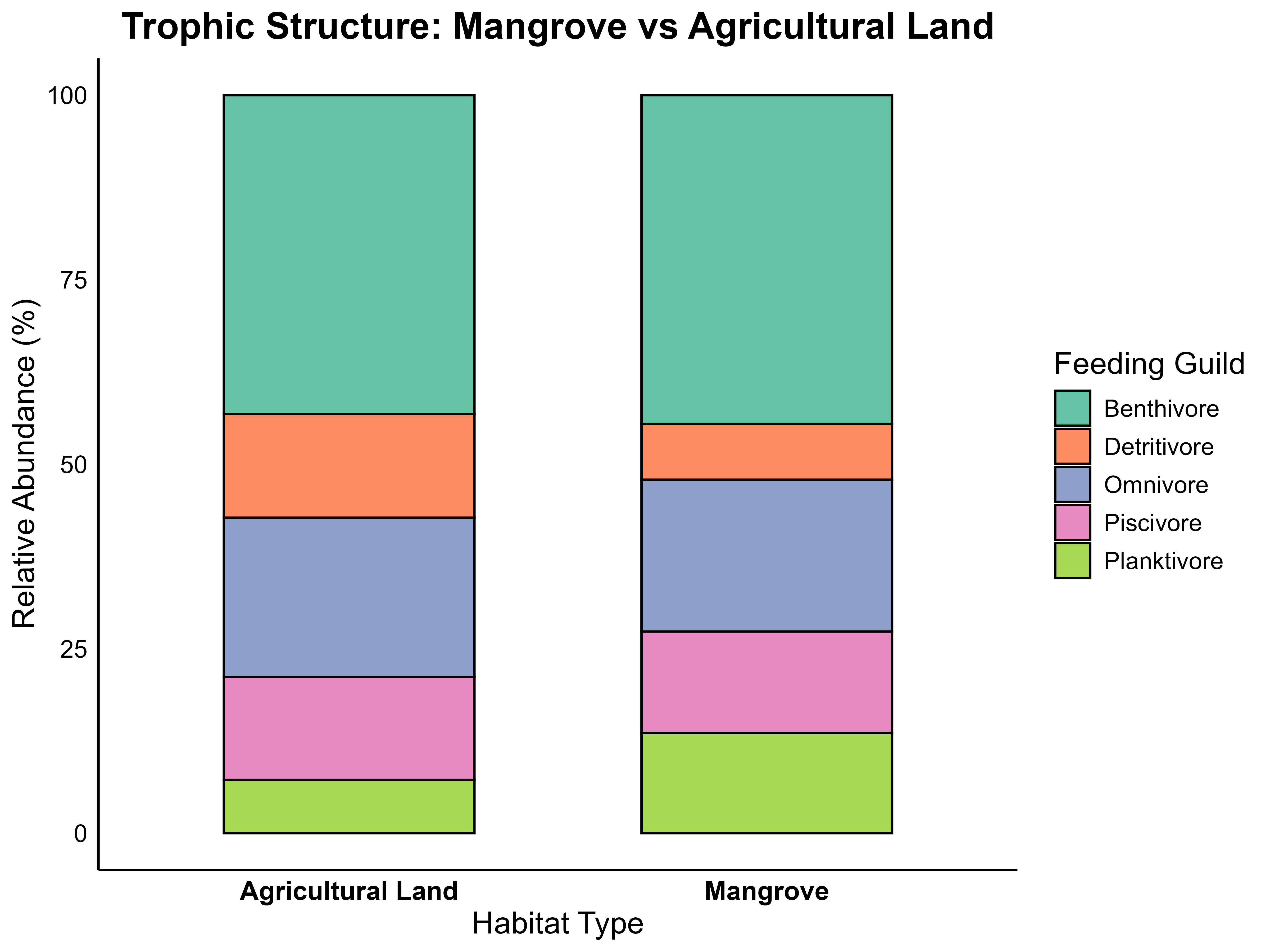
Figure 5: Relative abundance percentage of functional feeding guilds (Benthivores, Detritivores, Omnivores, Piscivores, Planktivores) comparing mangrove forest and agricultural land ecosystems.
Contact:
Ko Ko Tun Thwin (Thwin Ko Ko Tun), Xiao Yong Chen
Kunming Institute of Zoology, Chinese Academy of Sciences,
Kunming, Yunnan 650201, China
E-mail: thwin@mail.kiz.ac.cn (TKKT), chenxy@mail.kiz.ac.cn (XYC)