
Research Progress
One Gene, Two Paths: How Opposite Synaptic Defects Converge on the Same Intellectual Disability
A study led by the Kunming Institute of Zoology, Chinese Academy of Sciences, reframes ZC4H2-associated rare disorder (ZARD) as a "disease spectrum" rather than a single-mechanism condition. Published in Neuron under the title “Opposing Excitatory and Inhibitory Synaptic Pathologies Drive ZC4H2-Associated Intellectual Disability”,the work shows that different pathogenic mutations in the same gene can produce nearly identical cognitive deficits through diametrically opposite synaptic mechanisms—and that intervention should follow the mutation, not just the diagnosis.
ZARD is an X-linked neurodevelopmental disorder characterized by intellectual disability, epilepsy, and joint contractures. The team, led by Dr. Nengyin Sheng, previously demonstrated that ZC4H2 is a postsynaptic regulator for excitatory synaptic activity and brain cognition by modulating the protein stabilities of AMPA receptor subunits GluA1 and GluA2 (PMID: 40632560). Clinically, patients carrying different ZC4H2 variants are usually grouped together, yet it remains elusive whether the underlying pathological mechanisms are convergent or divergent.
To answer this important scientific question, the team first expressed wild-type ZC4H2 and 23 pathogenic mutants in N2A cells. They identified two distinct classes: one lost the ability to regulate excitatory AMPA receptor subunits GluA1/GluA2 (loss-of-function), while the other retained AMPA regulation but abnormally suppressed inhibitory GABAA receptor subunits α1/β1 (gain-of-function). Electrophysiological recordings on hippocampal slices confirmed that the two classes specifically disrupted inhibitory and excitatory transmission, respectively.
To link mechanism to behavior, the researchers built two knock-in mouse models carrying representative patient mutations: ZC4H2L66H/y and ZC4H2R213W/y. Both showed comparable cognitive deficits—impaired novel-object recognition, social-memory loss, and defective spatial learning—without obvious motor or anxiety abnormalities. The synaptic readouts, however, pointed in opposite directions: ZC4H2L66H/y mice showed weakened GABAergic inhibitory transmission and impaired inhibitory long-term potentiation (LTP), while ZC4H2R213W/y mice showed heightened AMPAR-mediated excitatory transmission and impaired excitatory LTP.
Using TurboID proximity labeling, the team traced the divergence to two different E3 ubiquitin ligase pathways. The L66H mutant acquires a neomorphic interaction with MKRN2, which promotes polyubiquitination and destabilization of GABAA receptor subunits. The R213W mutant, by contrast, disrupts ZC4H2’s interaction with RNF220, reducing RNF220 stability and lowering ubiquitination of AMPA receptor subunits, leaving excitatory synapses overactive.
Genetic rescue experiments confirmed this specificity: forebrain excitatory-neuron knockout of MKRN2 rescued only the L66H model, while expression of a degradation-resistant RNF220 variant rescued only the R213W model.
On the therapeutic side, the team repurposed two clinically used drugs. The GABAA agonist muscimol restored inhibitory transmission and cognition in ZC4H2L66H/y mice but had no effect in ZC4H2R213W/y mice, whereas the AMPAR antagonist perampanel produced the opposite pattern. This clean crossover supports a mutation-stratified intervention strategy rather than a one-size-fits-all approach.
The study’s significance extends beyond ZARD. By demonstrating that phenotypic similarity can mask mechanistic opposition, it argues for incorporating molecular pathology—not just gene identity or clinical symptoms—into disease stratification for neurodevelopmental disorders. In a field where more than 2,500 intellectual-disability genes are known, the work offers a generalizable principle: precision intervention requires matching the drug to the synaptic mechanism of the mutation.
Reference: Opposing excitatory and inhibitory synaptic pathologies drive ZC4H2-associated intellectual disability
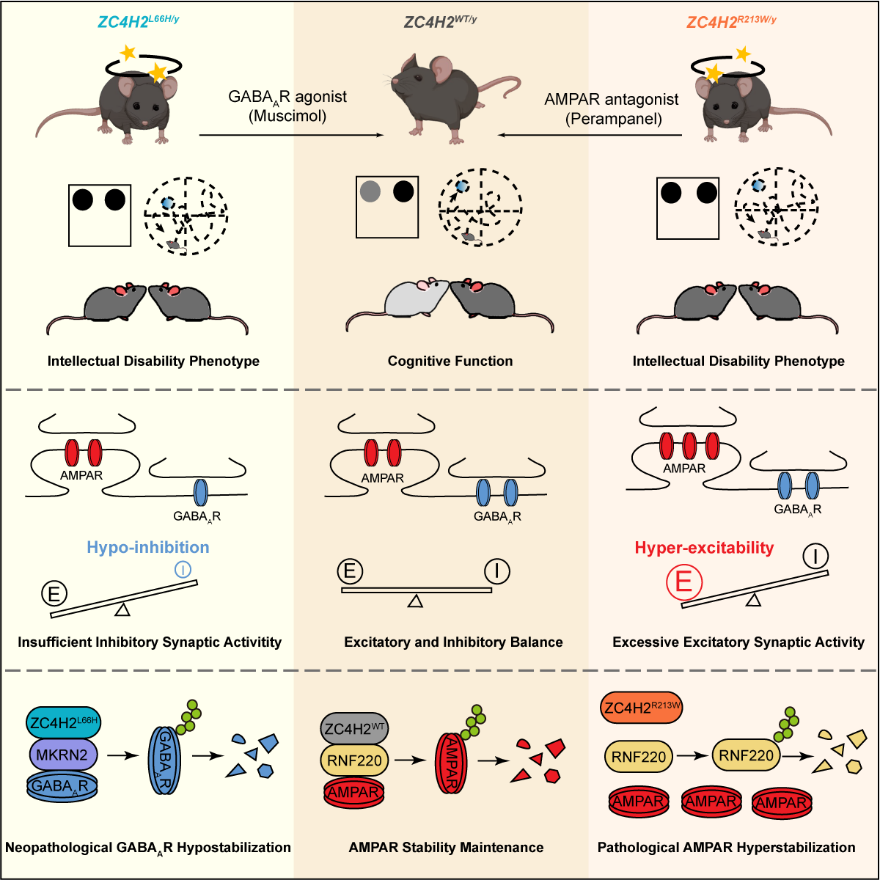
Same gene, different mutations: the puzzle behind similar cognitive deficits
Contact:
Sheng Nengyin
Kunming Institute of Zoology, Chinese Academy of Sciences,Kunming, Yunnan 650201, China
E-mail: shengnengyin@mail.kiz.ac.cn