The perinatal period is characterized by a critical physiological challenge: the high risk of hemorrhage during delivery. Simultaneously, pregnancy-associated venous thromboembolism (VTE) remains a leading cause of maternal morbidity and mortality, with risks increasing significantly during pregnancy and the early postpartum period. This creates a complex "bleeding-thrombosis" trade-off regarding hemostatic homeostasis. However, the underlying regulatory mechanisms have remained unclear.
A research team led by Prof. LAI Ren from the Kunming Institute of Zoology of the Chinese Academy of Sciences has found that estrogen significantly upregulates lactoferrin, which in turn enhances the activity of coagulation Factor XIa (FXIa), thereby promoting thrombin generation and thrombus formation. This study was recently published in Blood.
The researchers observed that plasma lactoferrin levels in pregnant women were significantly higher than in non-pregnant controls. Furthermore, pregnant women with VTE exhibited even higher levels of this protein - a phenomenon consistently validated in mouse pregnancy models.
The study demonstrated that the significant increase in estrogen during pregnancy transcriptionally upregulates lactoferrin expression via Estrogen Response Elements (EREs) within the lactoferrin gene promoter, thereby driving pregnancy-associated thrombosis.
In lactoferrin-knockout mice, both plasma recalcification time (PRT) and activated partial thromboplastin time (aPTT) were significantly prolonged, while the weight of inferior vena cava thrombi and plaque area were markedly reduced.
Treatments involving lactoferrin antibodies, lactoferrin knockout, or the specific interfering peptide HS9 (targeting the lactoferrin - FXIa interaction) all significantly inhibited thrombosis in pregnant mice. Notably, the HS9 demonstrated a significantly lower bleeding risk at effective anticoagulant doses compared to heparin.
This study establishes lactoferrin as a key regulator of the pregnancy-associated hypercoagulable state, upregulated under estrogen control, and elucidates the lactoferrin-FXIa axis as a potential therapeutic target for anticoagulation, providing a novel and safer strategy for the prevention and management of VTE during pregnancy.
Furthermore, the study highlights a fascinating biological trade-off. As a vital nutritional protein in breast milk, lactoferrin is significantly upregulated by estrogen during the perinatal period. This regulatory process serves a dual purpose: providing essential nutrients to the newborn and offering hemostatic protection against maternal hemorrhage. However, it simultaneously induces a maternal tendency toward hypercoagulability and thrombotic risk. The researchers suggest this trade-off is likely a physiological adaptation designed to balance maternal bleeding and thrombosis risks while ensuring neonatal nutritional supply.
This work was supported by the National Key Research and Development Program of China, the National Natural Science Foundation of China, Yunnan Provincial Science and Technology Department, New Cornerstone Investigator Program from Shenzhen New Cornerstone Science Foundation, among others.
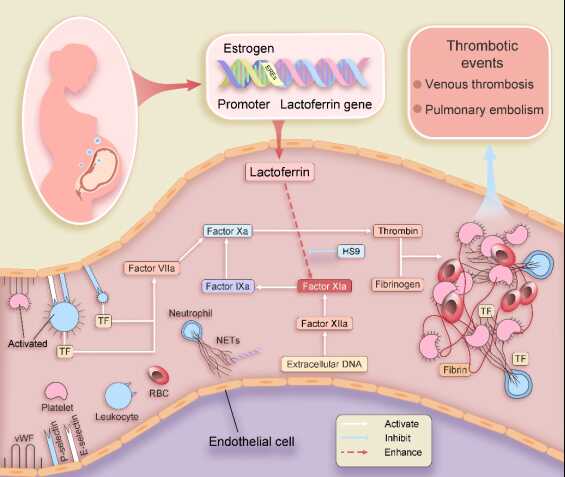
The mechanism of the lactoferrin-mediated regulation of perinatal coagulation homeostasis.