The genus Mustura (Cypriniformes: Nemacheilidae) is distributed from the Yarlung Tsangpo River to the Mekong River basin, occurring mainly in northeastern India, Myanmar, northern Thailand, and Laos. During ichthyological surveys conducted in the Chindwin–Irrawaddy River basin, the research team collected a series of nemacheilid loach specimens. Detailed morphological comparisons combined with molecular phylogenetic analyses confirmed that these specimens represent a previously undescribed species, which has been named Mustura arenaria sp. nov.
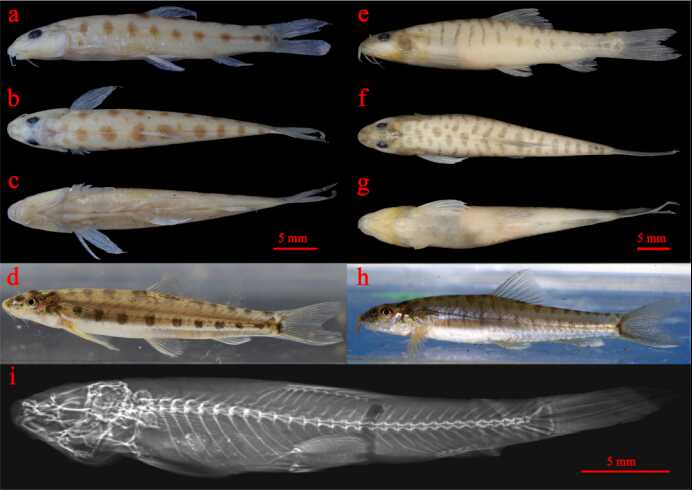
Figure 1. Mustura arenaria. a–d. Lateral, dorsal, and ventral views and a living photo of male, holotype SEABRI 20164206, 29.3 mm SL; e–h. Lateral, dorsal, and ventral views and a living photo of female, paratype SEABRI 20170634, 39.0 mm SL (h is 180° inverted); i. X-ray of paratype SEABRI 20192385, 29.9 mm SL.
Morphologically, M. arenaria is most similar to Mustura chindwinensis from the same drainage but can be distinguished by a combination of characters, including lateral body bars that are distinctly narrower than the interspaces, the presence of sexual dimorphism, a notched upper lip, and a spoon-shaped lower jaw. Phylogenetic analyses based on mitochondrial Cyt b and nuclear RAG1 genes strongly support the validity of M. arenaria as a distinct species. Genetic distance analyses of the Cyt b gene revealed interspecific divergences of 13.49%–16.16% between M. arenaria and other congeners.
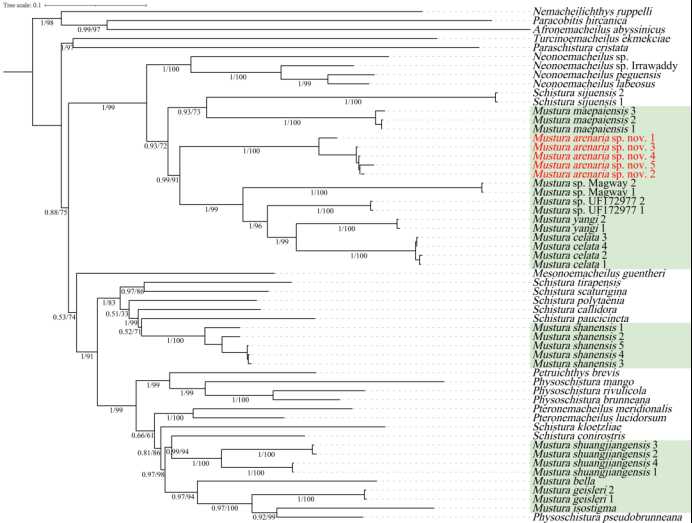
Figure 2. Bayesian phylogram of Mustura based on combined data of Cyt b and RAG1 sequences. Numbers on branches represent PP from BI and BS from ML. A green background indicates Mustura species.
In addition, the phylogenetic results indicate that the genus Mustura is polyphyletic. A re-examination of topotypic material of Mustura shanensis, together with molecular evidence, shows that this species is more closely related to members of the genus Schistura. Accordingly, the study supports transferring M. shanensis to Schistura. Given the observed incongruence between genetic and morphological characters within Mustura, the authors emphasize the need for a comprehensive taxonomic revision of the genus and its closely related taxa, incorporating broader species sampling.
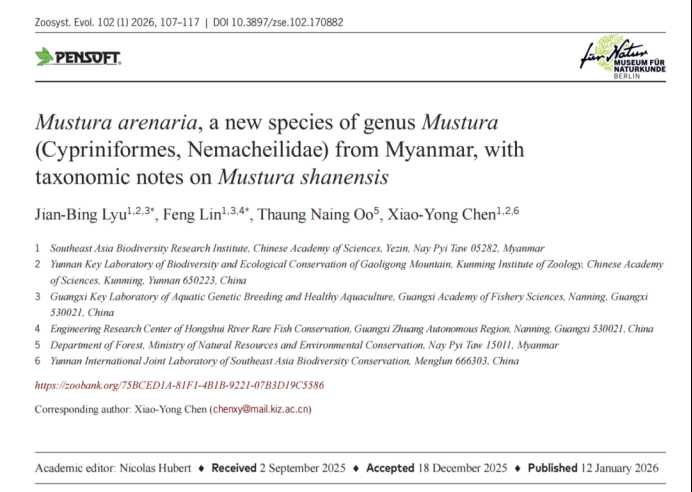
The study, entitled “Mustura arenaria, a new species of genus Mustura (Cypriniformes, Nemacheilidae) from Myanmar, with taxonomic notes on Mustura shanensis,” was published in the international zoological journal Zoosystematics and Evolution. Jianbing Lyu (Kunming Institute of Zoology, CAS) and Feng Lin (Guangxi Academy of Fishery Sciences) are co-first authors, with Xiaoyong Chen as the corresponding author. Thaung Naing Oo (Forest Department, Ministry of Natural Resources and Environmental Conservation, Myanmar) is a co-author.
This research was supported by the Southeast Asia Biodiversity Research Institute, Chinese Academy of Sciences (Y4ZK111B01); the Position of Bioclassonomist of the Chinese Academy of Sciences (CAS-TAX-24-054); the Project of Financial Funds of the Ministry of Agriculture and Rural Affairs: Investigation of Fishery Resources and Habitat in the Pearl River Basin (ZJZX-04).