In a study published in Aging Cell on June 26, 2026, a team led by Prof. He Yonghan from the Kunming Institute of Zoology (KIZ) of the Chinese Academy of Sciences, along with collaborators, revealed that the primate-specific long non-coding RNA LINC01021 plays a key role in regulating cellular and organismal aging. Aging research has long focused on protein-coding genes and canonical pathways such as mTOR and insulin/IGF-1 signaling, while the functions of non-coding RNAs that emerged during rapid primate evolution in aging regulation remain poorly understood. The researchers found that LINC01021 was significantly upregulated across multiple cellular senescence models, including replicative senescence, radiation-induced senescence, and drug-induced senescence. Functional experiments demonstrated that knockdown of LINC01021 attenuated cellular senescence phenotypes, whereas its overexpression accelerated irreversible growth arrest. Mechanistically, LINC01021 localizes predominantly to the nucleus and binds specifically to the RNA-binding protein DAZAP1, promoting RBMX mRNA degradation and reducing RBMX protein levels. This activates the P53-associated senescence program, establishing a trans-hierarchical regulatory axis: LINC01021-DAZAP1-RBMX-P53. This represents the first demonstration that a primate-specific lncRNA regulates aging through an RNA-binding protein-mediated signaling cascade. To validate LINC01021 function at the organismal level, the team generated humanized LINC01021 transgenic mice. These mice exhibited significant declines in physical function, reduced motor coordination, and disrupted tissue homeostasis, with particularly pronounced effects on the immune and motor systems. These findings provide direct in vivo evidence that primate-specific non-coding RNAs can regulate aging and suggest that lncRNAs may serve as potential targets for interventions against aging and age-related diseases. Reference: Primate-specific lncRNA LINC01021 contributes to cellular and organismal aging via DAZAP1-dependent destabilization of RBMX, Aging Cell (2026). DOI: https://onlinelibrary.wiley.com/doi/10.1111/acel.70603 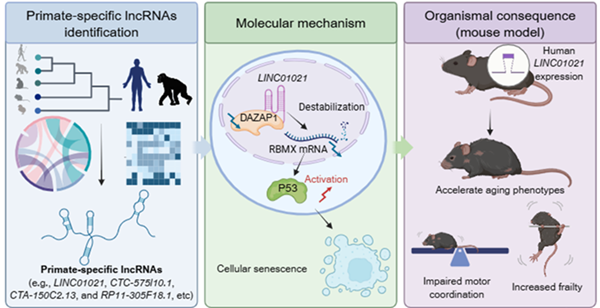 Schematic diagram of the mechanism by which LINC01021 promotes cellular and individual aging Schematic diagram of the mechanism by which LINC01021 promotes cellular and individual aging
|